Rising 200 metres above the surrounding jungle plains of Sri Lanka’s Cultural Triangle, Sigiriya — known locally as Sinhagiri or Lion Rock — is one of the most dramatic and rewarding climbs a tourist can make anywhere in Asia. It is not technical mountaineering. There are staircases, handrails, and designated rest points. But make no mistake: Sigiriya rock climbing is a genuine physical challenge that rewards those who prepare properly and punishes those who do not.
The ancient rock fortress at the summit, built by King Kashyapa in the 5th century AD, is a UNESCO World Heritage Site. The climb to reach it takes you past world-famous frescoes, through the jaws of a giant lion gateway, up near-vertical staircases clinging to sheer rock faces, and finally onto a plateau where an entire royal palace once stood — with 360-degree views across jungle, paddy fields, and distant mountains that will stop you completely in your tracks.
Every year, thousands of tourists from around the world make the ascent. Some find it easier than expected. Others find it significantly harder. The difference almost always comes down to preparation.
This guide gives you 15 essential things you must know before climbing Sigiriya, a step-by-step climbing guide structured for practical use, answers to the most frequently asked questions, and everything else you need to make your Sigiriya rock climbing experience safe, enjoyable, and unforgettable.
15 Things Tourists Must Know Before Sigiriya Rock Climbing
1. It Is Not Technical Climbing — But It Is Still Demanding
Sigiriya rock climbing does not require ropes, harnesses, or any prior climbing experience. The entire route follows staircases, metal walkways, and paved paths. However, the climb involves approximately 1,200 steps, significant elevation gain, steep sections with near-vertical staircases, and exposure to open height on narrow metal platforms. If you have a moderate level of fitness and no severe fear of heights, you can do it. But do not underestimate it.
2. The Entrance Fee Is Significant — Budget for It
Foreign tourists pay a premium entrance fee to Sigiriya, which is among the higher admission fees in Sri Lanka. As of recent years, the cost for adult foreigners is approximately USD $30 to $35 per person. Children under 12 are charged a reduced rate. Sri Lankan nationals pay a substantially lower fee. Always carry the correct amount in cash or confirm whether card payment is accepted at the time of your visit, as payment systems at the site do change.
3. Early Morning Is the Only Sensible Time to Climb
The gates at Sigiriya open at 7:00 AM. Arrive as close to opening time as possible. The reasons are threefold: the temperature at dawn is far more manageable than the brutal midday heat; the early light on the frescoes and surrounding landscape is spectacular for photography; and the crowds are significantly thinner. By 10:00 AM, the queues on the narrow staircases can become congested and the heat becomes a genuine physical factor. Plan to be at the entrance gate no later than 7:15 AM.
4. The Climb Has Four Distinct Sections
Understanding the structure of the climb helps you pace yourself correctly:
- Section 1 — The Lower Gardens: Flat, landscaped, easy walking through the ancient water gardens and boulder gardens at the base. Allow 15–20 minutes.
- Section 2 — The Fresco Gallery Staircase: A steep, narrow spiral staircase cut into the rock face leading to the famous 5th-century frescoes painted in a sheltered rock overhang. This section involves exposure and height. Allow 20–30 minutes.
- Section 3 — The Mirror Wall and Lion’s Paw Terrace: A narrow path along the rock face past the ancient polished mirror wall, leading to the iconic Lion’s Paw platform — the remnant of a giant lion gateway through which visitors once entered the summit. Allow 15–20 minutes.
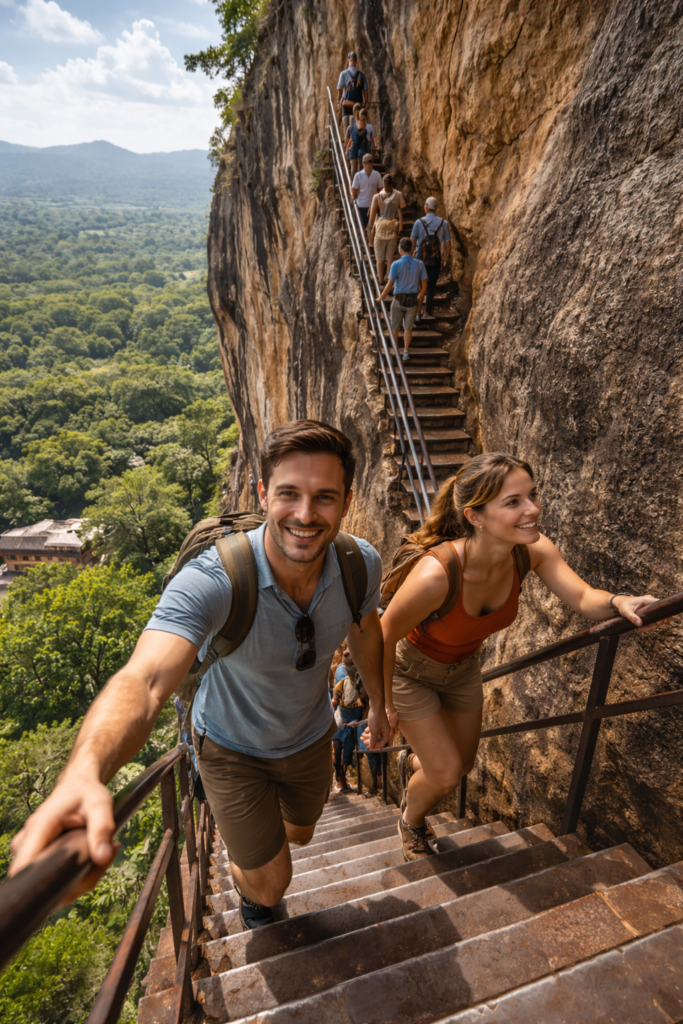
- Section 4 — The Summit Staircase: The most demanding section. A steep, near-vertical iron staircase climbs the final face of the rock to the summit plateau. This is where fitness, nerve, and pacing matter most. Allow 20–30 minutes.
5. The Frescoes Are a Highlight — Give Them Time
Midway up the rock, inside a sheltered overhang accessible via a spiral staircase, are the famous Sigiriya frescoes — ancient paintings of celestial women (apsaras) rendered in vivid ochre, red, green, and black pigments that have survived over 1,500 years. Originally there were over 500 figures; today 21 remain visible. Photography inside the fresco shelter is strictly prohibited. Take the time to observe them carefully — they are among the best-preserved examples of ancient South Asian art in existence.
6. The Mirror Wall Has Over a Thousand Years of Graffiti
Just past the frescoes, a narrow path follows the Mirror Wall — a polished plaster surface so reflective that King Kashyapa could reportedly see his reflection in it. Over the centuries, visitors left inscriptions on this wall, and some date back to the 8th century AD, making it one of the oldest collections of graffiti poetry in the world. Touching or defacing the wall is a serious offence. Simply observe it and appreciate the extraordinary span of human history it represents.
7. The Lion’s Paw Platform Can Trigger Vertigo
At the base of the final summit staircase, you arrive at the Lion’s Paw Terrace — a large rock platform where two enormous carved lion paws mark what was once the entrance to a colossal lion statue through whose mouth visitors entered the final climb. This section offers dramatic open views and is also where many tourists feel the full impact of the height for the first time. Take a moment to rest, hydrate, and steady yourself before tackling the final staircase. There is no shame in pausing here.
8. The Final Staircase Is the Hardest Part — Here Is How to Handle It
The iron staircase from the Lion’s Paw to the summit is steep, narrow, and exposed on both sides. Handrails are provided but the staircase is only wide enough for one-way traffic at certain points, meaning you will need to pause and yield to descending climbers. Go slowly. Keep one hand on the rail at all times. Do not look straight down if you are sensitive to heights. Focus on the step immediately in front of you. Once at the top, the effort dissolves instantly into the view.
9. The Summit Rewards Every Step
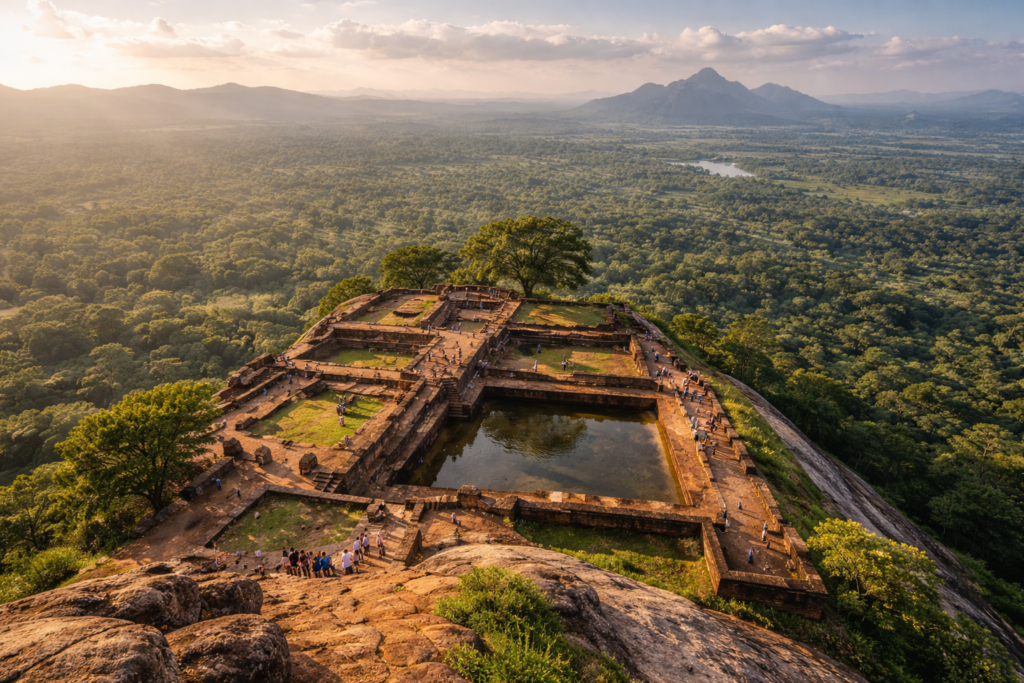
The summit plateau of Sigiriya covers approximately 1.6 hectares. Once a complete royal palace with throne rooms, pools, and gardens, today the foundations and outlines of these structures remain clearly visible. The 360-degree view from the summit is extraordinary — the jungle stretches to every horizon, with Pidurangala Rock visible to the north, the ancient tanks of Minneriya and Kaudulla glinting in the distance, and on a clear day, mountains beyond the plains. Spend at least 20 to 30 minutes at the top. You have earned it.
10. Wasps Are a Real Hazard — Take Them Seriously
Sigiriya has a known wasp problem, particularly around certain sections of the rock face. The site management has emergency protocols in place, and warning signs are posted in areas of known wasp activity. If you encounter a swarm, do not run or swat. Move slowly and calmly away from the area. Follow the instructions of any site staff immediately. Wasp stings on the narrow staircases have caused accidents in the past. This is not meant to alarm you — incidents are relatively rare — but it is a real consideration that every climber should be aware of.
11. Dress Appropriately — Modesty and Practicality Both Matter
Wear light, breathable clothing that covers your shoulders and knees out of cultural respect, as Sigiriya is a sacred site in addition to a historical monument. Avoid flip-flops — the staircases require shoes with grip. A hat and sunscreen are essential, as significant portions of the upper climb are fully exposed to direct sun. Do not carry unnecessary weight in a backpack; every kilogram matters on the final staircase.
12. Water Is Non-Negotiable
Carry at least one litre of water per person for the climb. Dehydration in the tropical heat is a genuine risk, particularly if you are not acclimatised to Sri Lanka’s climate. There are vendors at the base selling water and coconuts, and occasionally a drinks stall partway up, but do not rely on these. Bring your water with you from the start.
13. Photography Rules Must Be Respected
Photography is permitted throughout most of the climb and the summit. It is strictly prohibited inside the fresco shelter. Drones are absolutely prohibited anywhere within the Sigiriya site and its surrounding protected area. Visitors found flying drones face serious legal consequences. The site also prohibits touching the ancient surfaces, frescoes, or mirror wall.
14. Allow at Least Three Hours for the Full Experience
Budget a minimum of three hours for your Sigiriya visit: approximately 90 minutes for the ascent (with stops at the frescoes and Lion’s Paw), 20–30 minutes at the summit, and 45–60 minutes for the descent and a walk through the lower gardens. Rushing the climb diminishes the experience and increases the risk of accidents on the steeper sections.
15. Combine Sigiriya With Pidurangala Rock for the Full Picture
If you want the single best photograph of Sigiriya, you will not get it from the summit. You will get it from Pidurangala Rock, a smaller rocky outcrop just 1.5 kilometres north of Sigiriya. Pidurangala offers an unobstructed elevated view of Lion Rock and is best climbed at sunrise. Many experienced travellers do Pidurangala at sunrise and Sigiriya itself later in the morning — a combination that covers both perspectives and makes for an extraordinary day.
How to Climb Sigiriya Rock: Step-by-Step Guide
How to Climb Sigiriya Rock Fortress — Complete Step-by-Step
Step 1: Arrive at the entrance gate by 7:00 AM The site opens at 7:00 AM. Arriving at or just after opening gives you the best light, the coolest temperatures, and the smallest crowds. Pre-purchasing your ticket online where available saves time at the gate.
Step 2: Purchase your entrance ticket Foreign adult tickets cost approximately USD $30–$35. Have your passport available as proof of nationality. Keep your ticket safely — it is checked at multiple points during the climb.
Step 3: Walk through the Water Gardens The path from the entrance leads through the ancient lower water gardens — a remarkable feat of hydraulic engineering. Take your time here. This is the easiest section and a good opportunity to warm up your legs and settle into the experience.
Step 4: Ascend to the Fresco Gallery Follow the path to the spiral staircase leading up to the fresco shelter. This section involves height and exposure. Move at a steady, comfortable pace and yield to descending visitors where the path narrows. No photography inside the fresco shelter.
Step 5: Follow the Mirror Wall path After the frescoes, a narrow walkway follows the ancient mirror wall along the rock face. Move carefully — the path is exposed. Take in the ancient inscriptions and the views across the jungle below.
Step 6: Rest at the Lion’s Paw Terrace Arrive at the Lion’s Paw platform and take a genuine rest. Drink water. Catch your breath. Observe the two giant carved lion paws and the views. Prepare yourself mentally and physically for the final staircase.
Step 7: Climb the summit staircase Take the iron staircase slowly and steadily, one hand always on the rail. Pause in designated rest areas when needed. Yield to descending traffic. Focus forward and upward.
Step 8: Explore the summit plateau Spend at least 20–30 minutes at the top. Walk the full perimeter of the summit plateau to take in views in every direction. Observe the palace foundations, the royal pool, and the throne area. Absorb the scale of what was built here 1,500 years ago.
Step 9: Descend carefully The descent is often harder on the knees than the ascent. Take the staircases slowly, particularly the iron summit staircase. Hold the rail. Allow ascending climbers priority on narrow sections.
Step 10: Complete the lower garden walk Back at the base, the boulder garden to the north of the rock contains ancient cave dwellings, carved cisterns, and inscriptions rarely visited by tourists. If energy allows, this area rewards those who explore it.
Frequently Asked Questions About Sigiriya Rock Climbing
Q: How difficult is the Sigiriya rock climb? A: Sigiriya is a moderately challenging climb suitable for most adults with average fitness. It involves approximately 1,200 steps, including a steep near-vertical iron staircase near the summit. There is significant height exposure on open platforms. It is not technical climbing and requires no specialist equipment.
Q: How long does it take to climb Sigiriya Rock? A: Allow 90 minutes to two hours for the ascent including stops. A full visit including the summit and descent typically takes three to four hours.
Q: Is Sigiriya rock climbing safe? A: Yes, for the vast majority of visitors. The site has handrails, designated walkways, and site staff. The main hazards are the heat, dehydration, and occasional wasp activity. Those with severe fear of heights, heart conditions, or significant mobility limitations should consider carefully before attempting the climb.
Q: What is the best time of day to climb Sigiriya? A: Early morning, arriving at the 7:00 AM opening time. This gives you the best light, lowest temperatures, and smallest crowds.
Q: Can elderly people or children climb Sigiriya? A: Older adults in good health regularly complete the climb successfully. Children from around age six upwards can typically manage it with adult supervision. The key factors are fitness, confidence with heights, and the ability to handle heat. Assess honestly for your specific situation.
Q: Are there toilets on the climb? A: Toilet facilities are available at the base of the rock. There are no toilet facilities during the climb itself. Use the facilities before beginning your ascent.
Q: Can I bring food and drink up the rock? A: Water is essential and should always be carried. Food is generally not recommended as it can attract wildlife, particularly wasps and monkeys. Eat before your climb and save your meal for after.
Q: Is photography allowed at Sigiriya? A: Photography is permitted throughout the site and summit except inside the fresco shelter, where it is strictly prohibited. Drones are completely banned across the entire site.
Q: What should I wear for the Sigiriya climb? A: Light, breathable clothing covering shoulders and knees, sturdy closed-toe shoes with grip, a hat, and sunscreen. Avoid sandals or flip-flops on the staircases.
Q: Is there a time limit at the summit? A: There is no strict time limit, but the site closes at 5:30 PM and all visitors must be descending well before then. Arriving early gives you the most flexible summit time.
Related Questions People Also Ask
- How many steps are there to climb Sigiriya Rock?
- Is Sigiriya harder to climb than Pidurangala?
- What is the best time of year to visit Sigiriya Sri Lanka?
- Can you climb Sigiriya in the rain?
- What is the history of Sigiriya Rock Fortress?
- How much does it cost to enter Sigiriya?
- What are the frescoes at Sigiriya?
- Is Sigiriya worth visiting for a day trip from Colombo?
- What should I do after climbing Sigiriya?
- How do I get to Sigiriya from Kandy or Colombo?
- What wildlife might I see at Sigiriya?
- Is Sigiriya accessible for people with disabilities?
Final Thoughts: Sigiriya Rock Climbing Is Worth Every Step
There are experiences in travel that transcend sightseeing and become something closer to a life memory. Standing on the summit plateau of Sigiriya — 200 metres above the Sri Lankan jungle, surrounded by the ruins of a 5th-century royal palace, with the horizon stretching in every direction — is one of those experiences.
The climb demands something from you. It asks for your energy, your patience on the steep staircases, your courage at the exposed sections. And in return it gives you something rare: the feeling of having genuinely earned the view in front of you.
Prepare properly, start early, carry water, pace yourself, and respect the site and its rules. Do those things and your Sigiriya rock climbing experience will be among the finest days of your travels in Sri Lanka.
Ready to visit Sigiriya? Foreigners travelling to Sri Lanka can easily book their Sigiriya experience and wider Sri Lanka itinerary online. Visit travelzoomlanka.com/event-suits to browse available tours and secure your booking. For personalised travel enquiries, reach the team directly via the contact page or explore the full range of Sri Lanka experiences at travelzoomlanka.com.